How to Stop Rewriting Prompts and Start Designing with AI: Breaking Down the BMad Method
Sound familiar? When an AI assistant generates perfectly functional code that completely misses your system's architecture? You ask it to fix one function, and it rewrites half the project, forgetting the context of previous discussions. At some point you find yourself thinking: it would've been easier to write it myself.
I recently stumbled upon an interesting project with 50 thousand stars on GitHub — BMAD-METHOD. The authors propose systematizing work with AI coders and transforming chaotic chat into a clear process with roles, context, and predictable results.

What's the problem with regular AI assistants
The main issue with large language models when writing code is the lack of long-term memory and implicit assumptions. The model doesn't know the history of your architectural decisions. If you haven't outlined the task down to variable names, the neural network starts filling in the gaps. And more often than not, it fills them in wrong for your codebase.
BMad Method advocates for an Agile AI-Driven Development (AiDD) approach. The idea is to lock down decisions explicitly and pass them between development stages. In this scheme, AI acts not just as code autocompletion, but as a process participant performing a specific role: from design to writing tests.
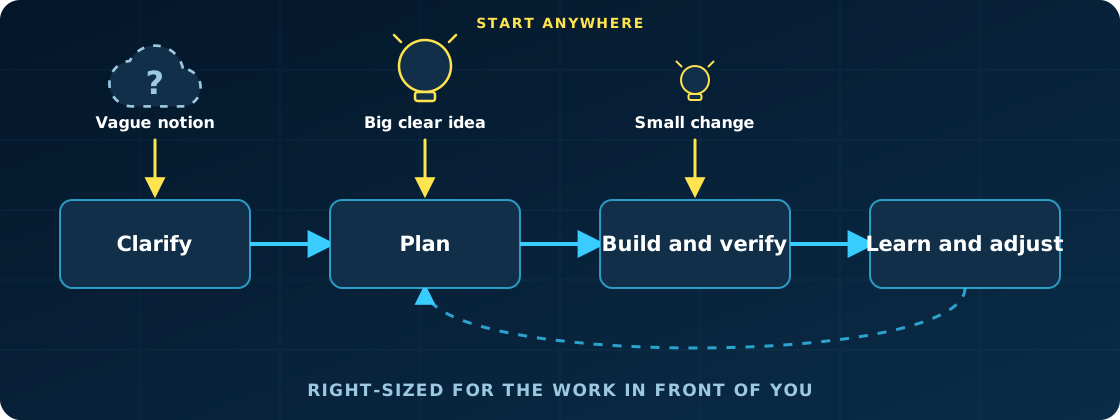
How the BMad system works
Instead of one endless thread with the neural network, the methodology breaks work into understandable steps. You don't have to run every minor task through the full cycle.
- Quick fixes. For targeted bug fixes or small improvements, you can call build commands directly, bypassing the long planning phase.
- Complex features. If you're launching a new module or changing architecture, the system helps you first formulate requirements, then assemble a specification, and only then hand the task off to development.
- Inherited context. All decisions are saved as artifacts (briefs, specifications, architectural notes) that the next AI agents read.
- Specialized roles. At each step, AI puts on a specific hat: product manager, architect, UX designer, or QA engineer.
The point is that the developer controls the decision points and makes the calls, while the tooling handles the tedious work of reconciling details.
Trying it out
To get started, you'll need Node.js 20.12+, Python 3.10+, and the package manager uv.
Installation is done with a single terminal command:
npx bmad-method install
After that, you open the project in your favorite editor with a built-in AI coder (for example, Cursor or Windsurf) and launch the task processing via bmad-build.
If you get confused about the stages or don't know which step to pick, a utility with hints helps out:
bmad-help
What's nice is that BMad doesn't force you to completely rewrite your processes. You can take just the part responsible for generating specifications or preparing architectural context, and write code in your usual way.
The ecosystem around the framework
BMad Method has grown into a whole family of specialized tools for different tasks.
| Module | What it's for |
| --- | --- |
| BMad Method | Main framework for planning and development |
| BMad Builder | Builder for custom agents and workflows |
| BMad Loop | Autonomous assembly, verification, and epic retrospective |
| BMad Test Architect | Module for designing testing on large projects |
Additionally, the authors have ready-made web kits for ChatGPT Custom GPTs and Google Gemini Gems. This is convenient when you need to think through a feature concept on your phone or in a browser, and then just send the ready files to your IDE.
Who it's made for
The framework is a great fit for those already actively using Claude Dev, Cursor, or GitHub Copilot, but who've hit an efficiency ceiling. If you're tired of writing super-long prompts explaining your project's architecture before every task, the BMad approach saves a ton of time.
On the other hand, if your tasks are limited to fixing a couple of lines in CSS or simple scripts, the BMad structure might feel excessive. But for average team development or services with a history, it's a perfectly viable way to tame the chaos in AI conversations.
Progetti correlati