How to Choose a Domain for Your Startup Without Endless Agony and Spreadsheets
Has this ever happened to you: you come up with a brilliant idea for a service, sit down to whip up a prototype in an evening, but stumble right at the very first step—the name? Personally, I've spent a combined dozens of hours on registrar websites, cycling through synonyms, suffixes, and exotic domain zones. Usually this process turns into chaos. You find a dozen available options, jot them down in notes, and then can't figure out which one sounds better, is easier to remember, and actually reflects the essence of the project.
Recently I stumbled upon the open-source project domainsearcher-app by Vasily Trofimchuk. The author approached the problem like an engineer: the tool doesn't just generate and check domain statuses—it scores each name based on mathematical and linguistic parameters.
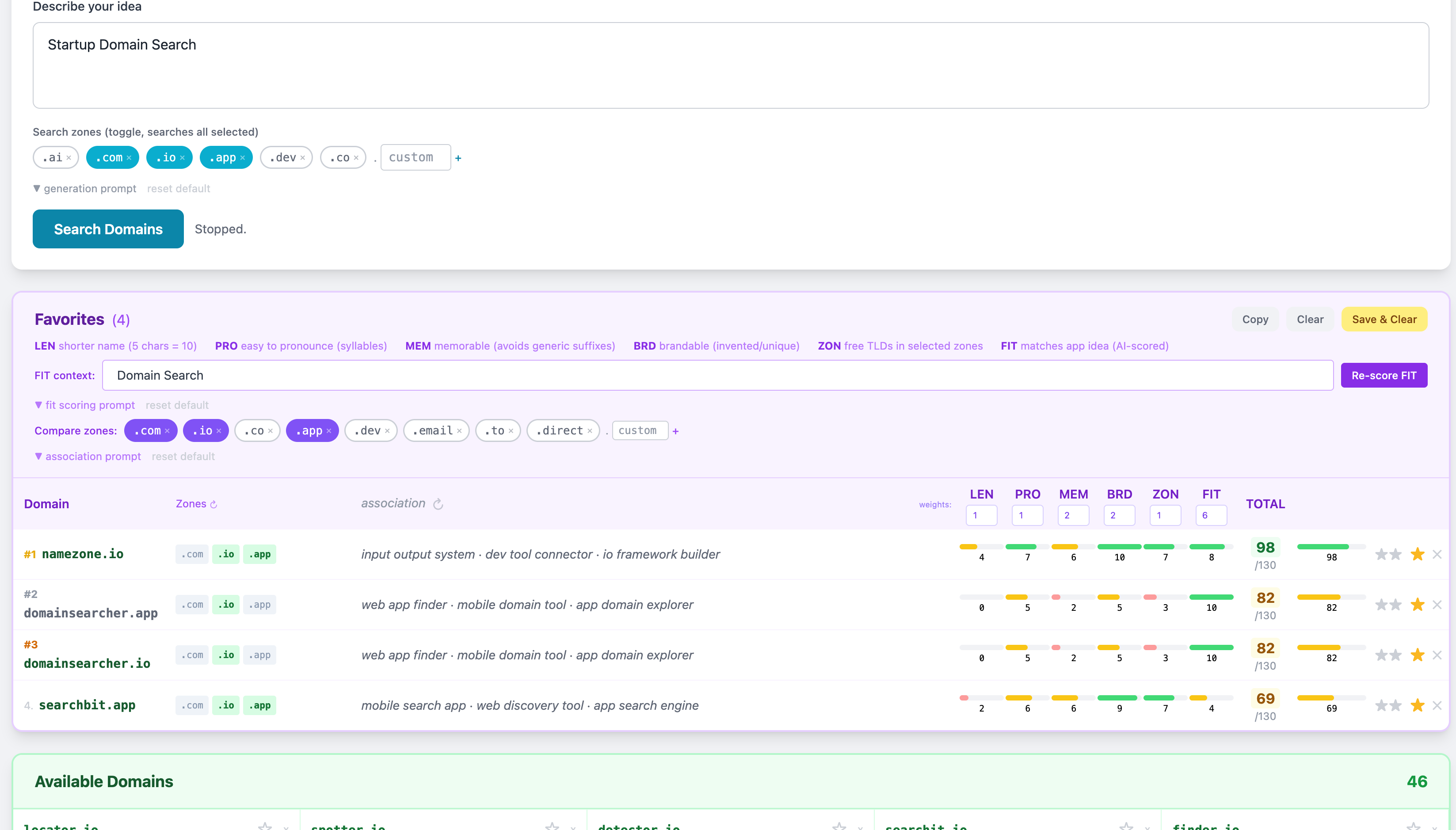
What's the main highlight
Most domain generators work on a primitive scheme: take a word, tack on prefixes like get, try or app, and show green checkmarks next to available zones.
Here the logic is different. The service generates around 60 candidates based on your idea description, immediately checks their availability, and assigns each candidate a weighted score.
The evaluation is built around six dimensions:
- LEN (Length). Calculated locally. The gold standard is 5 characters, which gets the maximum points.
- PRO (Pronounceability). A neural network evaluates how easy it is to say the name out loud without twisting your tongue.
- MEM (Memorability). Checks the probability that a user will remember the name the next day.
- BRD (Brandability). Assesses how unique the name is, how much it sounds like a company name rather than a faceless search query.
- ZON (Zone availability). Shows the percentage of availability across your selected domain zones (.com, .io, .ai, .dev, .app).
- FIT (Idea match). Analyzes how precisely the name conveys the product's meaning.
All neural network metrics (PRO, MEM, BRD, FIT) are requested in a single API call to save tokens and time. Meanwhile, the metric weights can be tweaked manually. If you don't care about length but product association is critical, you just increase the FIT weight and recalculate the final rating.
How availability checking works without a backend
The most interesting part of the repository is hidden under the hood. The project has no server-side backend at all. Everything runs directly in the browser via vanilla JavaScript (ES modules) and static HTML.
To check domain availability without an intermediate proxy server, the author implemented a two-step verification:
- RDAP (via rdap.org). This is a modern replacement for the WHOIS protocol with CORS support and JSON format. If the registry returns a 200 code, the domain is taken.
- DNS-over-HTTPS (via Cloudflare 1.1.1.1). Queries the A record of the domain. If a
NXDOMAINstatus is returned, the domain is free. If NS or SOA records come back in the Authority section, the name is already taken by someone.
This combination helps catch false results on finicky zones like .io, .ai or .co, where registries often respond with errors or delays.
Working with neural networks and keys
By default, the web version already has a Groq key with a free tier built in, so the service works out of the box without registration.
If you need other models or want to remove limits, you can switch the provider in the interface and insert your own key:
- Groq (fast inference via open models)
- OpenAI
- Anthropic Claude
Keys are saved exclusively in the browser's localStorage and are never sent anywhere externally.
Another fun detail in the interface: for each selected domain, the service generates three associative words taking into account the meaning of the domain zone. For example, for .ai the focus is on artificial intelligence, and for .io on developer tools.
How to run locally
Since the project has no bundlers like Webpack or Vite, launching boils down to spinning up any static server. The main requirement: serve files over HTTP, otherwise the browser will block ES modules.
After that, you open the address in your browser, type a couple of sentences about your future project, select the zones you're interested in, and start the search. Favorites can be saved with a star, snapshots can be exported, and you can restore them later.
Is it worth trying
The project wins you over with its simplicity. No heavy frameworks, databases, or authorizations. It's a great example of how you can build a fully functional working tool on a vanilla stack using modern web standards (RDAP, DoH, Fetch API).
If you're currently brainstorming a name for a side project, library, or startup, check out domainsearcher.app or dig into the repository code. The idea of multi-factor scoring through a single LLM query will definitely come in handy for other tasks too.
Proyectos relacionados