Code on Anything with OpenClaude Portable
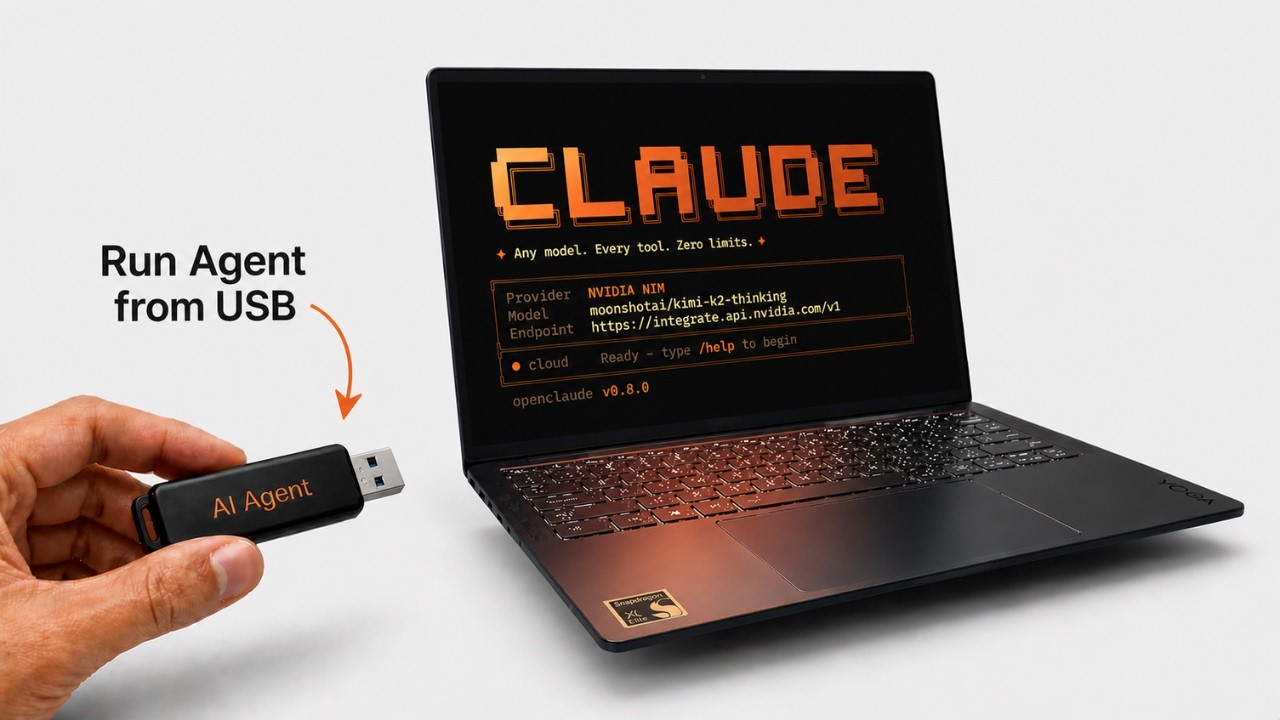
Imagine this: you visit a client or an office with strict security policies where third-party software can't be installed on workstations, and Node.js or Python are practically exotic for the local admins. You've got a regular USB drive in your pocket with a full-featured AI agent ready to write code, fix bugs, and set up environments. No system installation, no registry traces, no questions asked.
That's exactly what the OpenClaude-Portable project solves. It's a portable version of the OpenClaude engine, packaged to run straight from a folder.
What Is This Thing
Essentially, it's a wrapper around Claude Code (or its open-source equivalent) that carries everything needed. Developer techjarves bundled Node.js runtime, a proxy server for accelerating local models, and a user-friendly control panel into a single archive.
The real value isn't the AI itself—there are plenty of models available—it's the autonomy. The project follows a "unpack and go" approach. All settings, API keys, and conversation history stay contained in folder data/. Pull out the USB drive and there's not a single temporary file left behind.
What Makes This Project Stand Out in Practice
I frequently encounter tools claiming "easy setup" that actually demand half an hour of debugging npm errors. This one takes a different approach.
Running Without Node.js Installed
The repository contains scripts START.bat for Windows and start.sh for Unix systems. On first launch, they automatically fetch a portable Node.js version (roughly 25 MB) and the OpenClaude core. No need to clutter your main system with multiple runtime versions.
Smart Proxy for Local Models
If you've tried running heavy agents through Ollama on a standard laptop, you're familiar with the frustration—waiting for that first token can feel endless. The author built in local-proxy.js to intercept system prompts.
OpenClaude typically sends a massive 10,000-token instruction set. The proxy trims this down to the 300 most critical tokens. On lower-end hardware, this cuts response time from a full minute down to 10-15 seconds, making models like gemma3:1b or qwen2.5:1.5b viable even on CPU-only systems.
Multi-Provider Support
The project doesn't lock you into Anthropic. The list of supported APIs is impressive:
- Free tiers from NVIDIA NIM and Google Gemini.
- DeepSeek and OpenRouter for budget-conscious users.
- Full offline capability via Ollama or LM Studio.
- Any custom endpoint compatible with the OpenAI API.
Limitless Mode
In standard mode, the agent asks permission for every action: "Can I create this file?", "Can I run this script?". In Limitless mode, it transforms into an autonomous machine. This is handy for batch file processing or when you trust the model 100%, but be careful—the agent can cause serious damage to your code if left unsupervised.
Under the Hood
The project structure is transparent, which is uncommon for tools like this.
OpenClaude-Multi-Platform/
├── START.bat          # Точка входа для Windows
├── data/              # Твои секреты, логи и история
├── engine/            # Тот самый Node.js и само ядро
└── tools/             # Скрипты для смены провайдеров и настройки моделей
Cross-platform compatibility is well-implemented. Folder data/ is shared. You can start a session on Windows, save it, pull out the USB and plug it into a MacBook, and continue from where you left off using RESUME.bat (or a similar script on Linux).
Who Benefits
I see several scenarios where OpenClaude-Portable has an edge over traditional IDE plugins:
- Secure environment. When you can't install anything on the host but need an intelligent assistant.
- Testing local LLMs. A quick way to check how a particular model handles real coding tasks via Ollama.
- Switching workspaces. If you're constantly moving between office, home, and coworking spaces, it's easier to carry a configured agent with you than to sync configs everywhere.
Is It Worth Trying
If you need an AI agent that doesn't touch your system and is ready to work in 30 seconds, then definitely yes. The project is young, the README has a list of known issues (like slow performance on USB 2.0), but it's actively updated.
One caveat—initial launch still requires internet so the script can download Node.js and the engine. But after that, you can go fully offline if using Ollama.
You can try it out by simply downloading the repository:
git clone https://github.com/techjarves/OpenClaude-Portable.git
cd OpenClaude-Portable
# На Windows запускаем START.bat, на Linux — start.sh
This is a great example of how a useful tool becomes a convenient product through thoughtful packaging. No unnecessary hype or complex manuals.
Related projects