How to Train AI to Write Proper Documents Instead of Fluff
Recently I tried asking Claude to analyze a lease agreement. Got the standard response: "Note the payment clause, make sure all amounts are correct." Obvious advice that's not very useful in real life.
The main problem when working with neural networks comes down to context and task framing. We ask the model to do professional work, but get a school essay full of synonyms. Last week I came across the pm-claude-skills repository. The author collected over 700 clear instructions in plain Markdown files that turn vague prompts into clear algorithms.
Plain Markdown Instead of Complex Frameworks
There's no fancy runtime or heavy dependencies in the repository. Each skill is a simple SKILL.md file. Inside there's a strict structure: input data, decision rules, response template, and antipatterns the model should ignore.
The model reads such a file before executing a task and starts producing relevant results. The PM abbreviation stands for Professional, not just Product Manager. The catalog contains sets for engineers, lawyers, marketers, and designers.
Any skill looks something like this:
---
name: lease-decoder
description: "Decode a residential lease into plain English..."
---
## Framework: Severity Scale
Red: Can cost you real money — auto-renewal, break penalties
Yellow: Unusual clauses requiring clarification
Green: Standard fair terms
No proprietary code involved. The text is human-readable, can be customized for your needs, or committed directly to a project repository.
What's Interesting Inside
I reviewed the catalog and identified four areas that seemed most practical:
Document decoders. Instructions for parsing lease agreements, invoices, or employment terms prompt the AI to identify potential issues. If a document contains automatic renewal clauses or excessive penalties, the model highlights them first with a color-coded risk assessment.
Complex conversation simulators. You can rehearse scenarios before interviews, thesis defenses, or salary negotiations. The model plays a demanding opponent, then steps out of character to provide feedback on mistakes made.
Token optimization in the pm-tokens package. The authors built Python utilities that compress JSON arrays and generate compact repository maps. This reduces unnecessary context for agents, cutting API costs noticeably.
Prompt validation tools. The npx pm-claude-skills prove team runs A/B tests comparing model responses with and without skills enabled, tracking exact token usage and output quality.
How to Install and Use
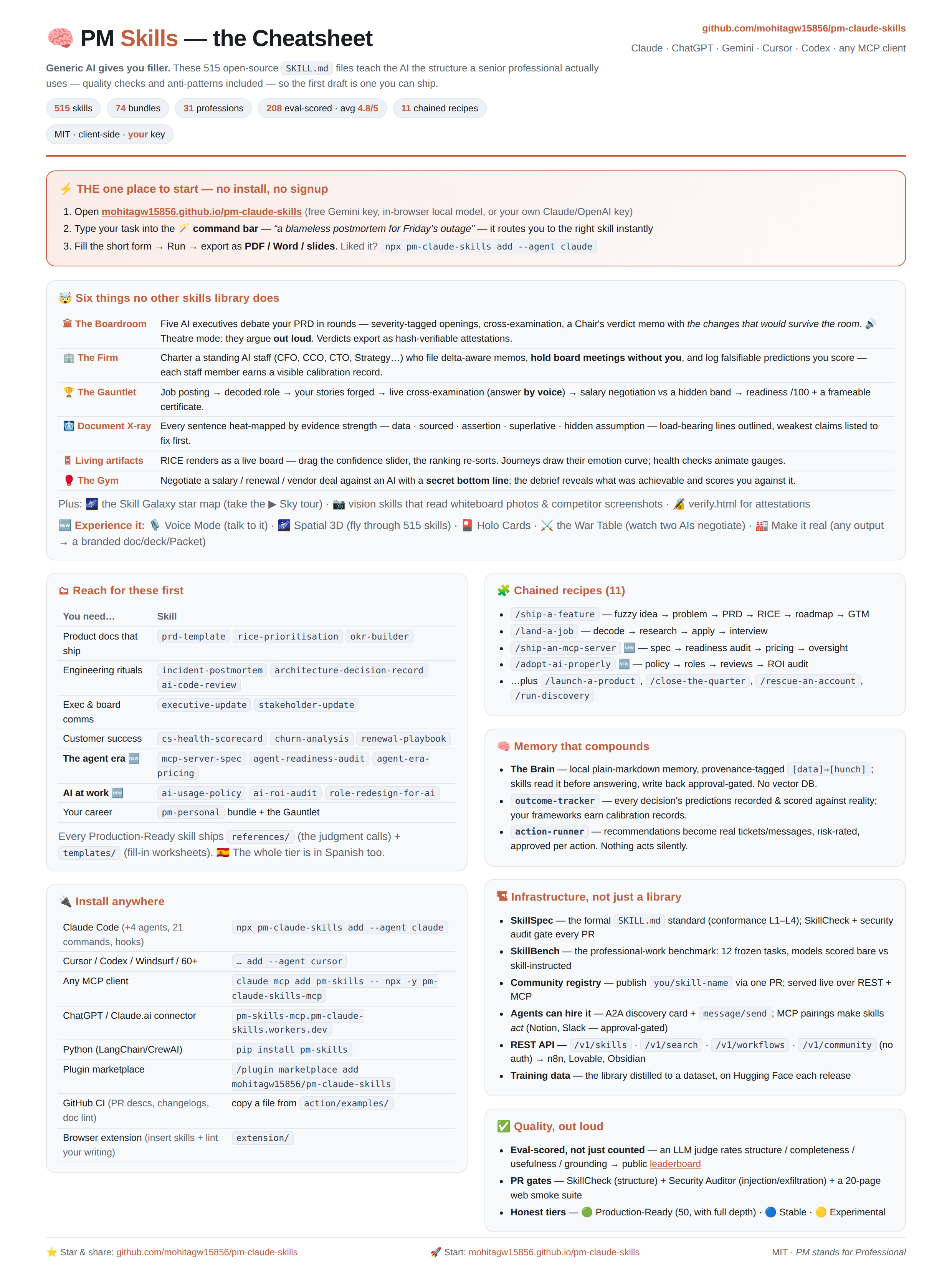
For Cursor, Windsurf, Codex, or Aider users, skills can be added with a single npx command:
npx pm-claude-skills add --agent cursor
Claude Code integrates the project as an official plugin via the /plugin command. Those preferring web interfaces like ChatGPT or Gemini will find ready-made text versions in the exports/ folder that copy directly into system instructions.
For reference, the author created a cheat sheet covering all commands and library features:
Is It Worth Installing
The project stands out by avoiding the bloated all-in-one tool trap. It's a transparent knowledge base validated through CI and automated tests. If you're tired of repeatedly explaining to the model what format to use for specs, code reviews, or email triage, you'll find ready-made solutions here.
All files are MIT licensed. You can safely use them as a foundation, fork them, and customize for your company's workflows.
Related projects