Try to Survive as a Task Scheduler
We're used to cursing the operating system when the interface freezes or an application goes into a silent "Not Responding." It seems like distributing CPU time and memory across a dozen programs is a trivial task. But what if you're the one sitting at the task manager?
The You're the OS! project by developer Pier-Luc Brault turns fundamental Computer Science concepts into a hardcore arcade game. Here you literally become the system kernel. Your goal is to manually allocate memory, switch process contexts, and handle I/O interrupts. A few seconds late — and an angry user will hit the Reset button.
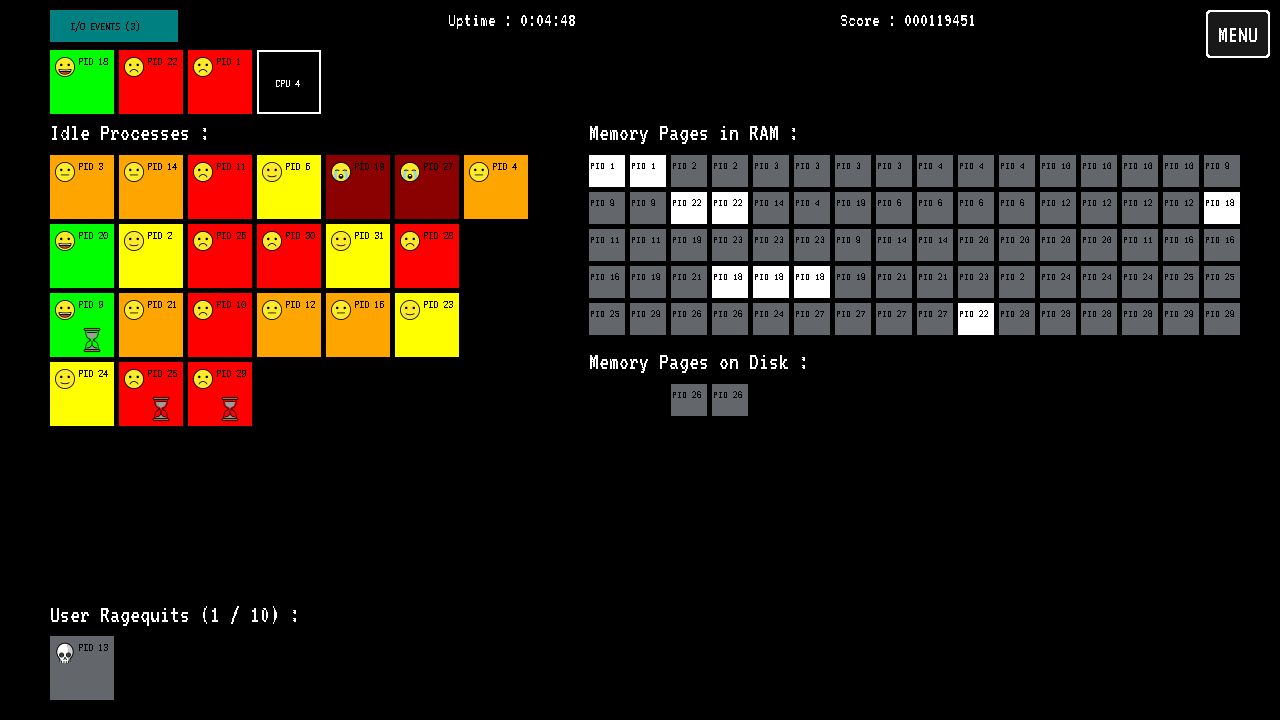
How the Gameplay Works
System queues continuously spin on screen. Each process needs CPU time, a block in RAM, or a response from the disk.
You have to keep track of several parameters at once:
- Load on the ready-to-run thread queues.
- Allocation and cleanup of RAM pages.
- I/O requests that block program execution.
- The user's patience meter, which drains with each cycle of idle time.
If you leave a task in waiting mode too long, the process starts to "boil over." Once the user's patience runs out, the game ends with a crash reboot.
Why Should a Programmer Play the Operating System
Beyond pure gaming excitement, the project provides a hands-on understanding of things we usually treat as abstractions in Tanenbaum's textbooks.
1. Hands-On Understanding of Scheduling
You feel in real time why algorithms like Round Robin or Fair Share are designed the way they are. Try manually avoiding a starvation situation when a heavy background thread completely clogs the pipeline while small interactive user clicks hang with no response.
2. Sandbox for Custom Scenarios
The repository includes a sandbox mode. You can describe your own workload profile in Python: set task spawn intensity, required memory volumes, and I/O operation types. This turns the game into a stress-testing bench.
3. API for Automation and Bot Writing
The most interesting part of the desktop version is the ability to control the system not with your hands, but with code. The repository contains the automation/skeleton.py module, through which you can connect your own scheduler script.
You write a resource allocation algorithm in Python, run the simulation, and see how many cycles your own scheduler lasts against the game's event generator.
Launch and Technical Details
The project is written in Python using the Pygame library, and the web version is compiled to WebAssembly. You can play right in the browser on GitHub Pages or itch.io.
If you want to write bots through the automation API, you'll need to run the project locally.
The repository states a strict version requirement: the author uses Python 3.14 and the package manager pipenv. For isolation, it's best to use pyenv right away:
# Клонируем проект
git clone https://github.com/plbrault/youre-the-os.git
cd youre-the-os

# Устанавливаем зависимости
pipenv sync --dev

# Запуск десктопной версии
pipenv run desktop

# Запуск собственного скрипта автоматизации
pipenv run auto automation/your_bot.py
To build a custom sandbox configuration, just create a file in the src/sandbox/ directory and run the command:
pipenv run sandbox sandbox.myConfig
Is It Worth Your Time
If you teach OS fundamentals, are looking for a way to exercise your brain on weekends, or want to write your own scheduler bot in Python, the project is definitely worth running for half an hour. It quickly humbles you and clearly explains why creating reliable task managers once took engineers decades.
Related projects