Autonomous Hacker in a Docker Container: How Decepticon Changes the Game for Red Team
Know that feeling when you launch yet another "AI pentest tool" and it just feeds nmap output to ChatGPT and asks it to analyze? Honestly, these half-baked solutions have gotten pretty old. Real hacking isn't about reading logs — it's a chain of actions: reconnaissance, persistence, privilege escalation, and lateral movement.
Recently I stumbled upon the Decepticon project from the folks at PurpleAILAB. It's not just a script wrapper, but an attempt to create a full-fledged autonomous agent for Red Team that behaves like a live pentester.

What Is This Beast
Decepticon is positioned as a professional agent for conducting attacks. The main difference from dozens of similar projects is that it doesn't just "scan" — it executes realistic attack chains. The developers claim that the agent can work with interactive shells (hello, msfconsole and sliver), understands rules of engagement, and plans operations using the MITRE ATT&CK methodology.
Interestingly, the project scored 98% on the XBOW benchmark. This means out of 104 tasks of varying difficulty, it successfully completed 102. For an autonomous system, that's a serious result.
How It Works Under the Hood
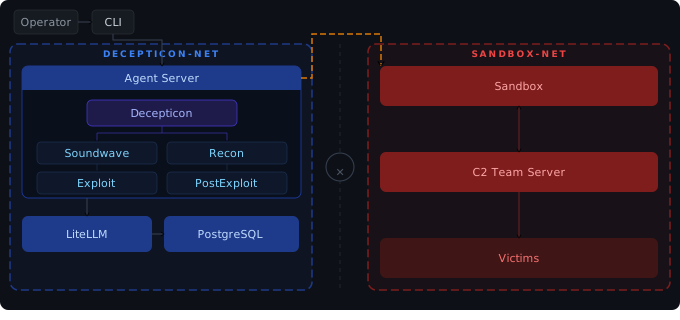
The project architecture looks mature. The developers split the system into two isolated networks. In one (decepticon-net) lives the "brain": PostgreSQL database, Neo4j knowledge graph, LangGraph orchestrator, and LiteLLM for connecting to neural networks. The second network (sandbox-net) is the sandbox. That's where Kali Linux runs in a container, along with command and control (C2) servers and the targets themselves.
This isolation ensures that the agent won't wreck your host machine if something goes wrong. Commands are executed inside tmux sessions, which allows the agent to "see" interactive command prompts and respond to them.
Team of Specialists
Instead of one massive prompt saying "hack everything for me," Decepticon uses 16 specialized agents. Each one is responsible for its own stage:
- Reconnaissance and data gathering.
- Vulnerability exploitation.
- Post-exploitation.
- Working with Active Directory and cloud infrastructures.
- Reverse engineering and smart contract analysis.
Each agent has its own context, which solves the "forgetfulness" problem of long LLM conversations. When one task is complete, the orchestrator passes the baton to the next specialized agent.
How to Launch and Try It
You can deploy everything with a single command via curl if you have Docker installed. Supported on macOS, Linux, and Windows (via WSL2 or natively).
curl -fsSL https://decepticon.red/install | bash
decepticon onboard   # Настройка ключей API и моделей
decepticon           # Запуск CLI
After launching, decepticon onboard will ask which models you want to use. The project supports pretty much everything: Anthropic, OpenAI, Gemini, local Ollama, and even DeepSeek. There are three workload profiles: eco (lightweight), max (best models for all tasks), and test (for debugging).
If you don't want to mess with Docker, the authors have a cloud version, but for thorough research, running locally via CLI seems more reliable.
Practical Benefits
Why would a regular developer or system administrator need this?
First, it's a great way to check your services for basic security vulnerabilities automatically. Decepticon generates an operation plan (OPPLAN) and reports that you can study.
Second, the project can be used as a library. If you're building your own monitoring or security tool, the Decepticon SDK lets you embed agent capabilities directly into your Python code.
pip install decepticon
Is It Worth It
The project looks very ambitious. I like that the authors aren't just chasing the AI hype — they're trying to instill discipline in the agent's work. It first generates RoE (rules of engagement) and only then starts acting.
On the downside, the project is quite resource-heavy since it spins up a whole bunch of containers, including Neo4j and specialized tools like BloodHound or Ghidra. But if you need not just a port scanner, but a tool that simulates a real attacker for testing your defenses — Decepticon is definitely worth spending an evening exploring.
Remember that you can only use tools like this on networks where you have written permission from the owner. Hacking others is illegal, but testing your own is beneficial.
Related projects