Why Vector Databases Won't Save Agents from Auditors and How Semantica Solves This
Imagine a real-world scenario. An AI agent at a financial company automatically rejected a loan application or set an interest rate. Six months later, a regulator shows up and asks a simple question: "On what basis did the system make this decision?"
If your agent relies solely on a vector database and standard RAG, you won't have an adequate answer. Vector embeddings can find similar text fragments based on semantic similarity. But they have no idea which facts contradict each other, which past precedents the model relied on, and what consequences this chain of reasoning led to.
This is where the Semantica framework comes in. The developers position it as an open-source alternative to Palantir for autonomous agents. The tool integrates directly under your agent framework, model, and vector store, adding a deterministic layer of graphs, rules, and audit.
Project Overview and Concept
Semantica is a Python library (pip install semantica) built around the concept of Context Graphs. Instead of relying on a language model to build logical connections, the library takes the deterministic work on itself. Building a knowledge graph, executing rules, or tracing LLM audit doesn't require an LLM at all.
The library architecture covers the full data processing cycle. Data comes from files, web pages, traditional databases, and enterprise platforms like Databricks and Snowflake. Raw text gets extracted, cleaned, and split into chunks based on entities. From these chunks, a knowledge graph forms that connects to deterministic inference engines (Rete, Datalog, SPARQL), W3C PROV-O standards, and decision logging modules.
Main Framework Capabilities
- Decisions as first-class objects. In conventional systems, agent decisions end up in logs or chat memory. In Semantica, calling
record_decision()creates a graph node with scenario, arguments, confidence, and metadata. Decisions are linked together through causal relationships. - Deterministic reasoning engines. Language models are prone to hallucinations when computing complex business rules. The framework includes Rete, Datalog, and forward chaining engines. You define rules in code, and the system verifies facts without LLM involvement, delivering transparent results.
- Conflict detection and deduplication. When a vector index receives two contradictory facts, it typically stores both or overwrites the old one. Semantica tracks such discrepancies, flags conflicts, and proposes resolution strategies: from source trust weighting to selecting the most recent fact.
- Storage flexibility without vendor lock-in. The storage layer is fully polyglot. You can work with RDF stores (Oxigraph, Blazegraph, Jena, RDF4J) via SPARQL or property graphs (Neo4j, FalkorDB, Apache AGE, AWS Neptune) via Cypher. Vector databases like Qdrant, Pinecone, Weaviate, or pgvector connect without changing the core code.
How It Looks in Code
Let's look at a basic scenario for recording a decision and tracking its causes.
from semantica.context import ContextGraph

graph = ContextGraph(advanced_analytics=True)

# Регистрируем решение о согласовании заявки
app_id = graph.record_decision(
    category="credit_application",
    scenario="Персональный кредит, доход 150k, DTI 31%",
    reasoning="Доход соответствует порогу, стабильный стаж работы",
    outcome="proceed_to_underwriting",
    confidence=0.88,
    metadata={"applicant_id": "A-7291"}
)

# Следующий шаг андеррайтинга
uw_id = graph.record_decision(
    category="loan_underwriting",
    scenario="Проверка андеррайтером для A-7291",
    reasoning="DTI в пределах нормы, чистая кредитная история",
    outcome="approved",
    confidence=0.94
)

# Связываем решения причиной и следствием
graph.add_causal_relationship(app_id, uw_id, relationship_type="CAUSED")

# Получаем всю цепочку для проверки или аудита
chain = graph.trace_decision_chain(uw_id)
similar = graph.find_similar_decisions("кредит с низким DTI", max_results=5)
Each decision made is exported in W3C PROV-O format, which regulators in financial and medical sectors accept.
Integrations and Ecosystem
The library provides ready-to-use deployment tools:
- A ready-made MCP server that connects Semantica to Claude Desktop, Windsurf, Cursor, or VS Code in a couple of minutes.
- Native integration with the multi-agent framework Agno, allowing multiple agents to share a common context graph.
- REST API on FastAPI and the
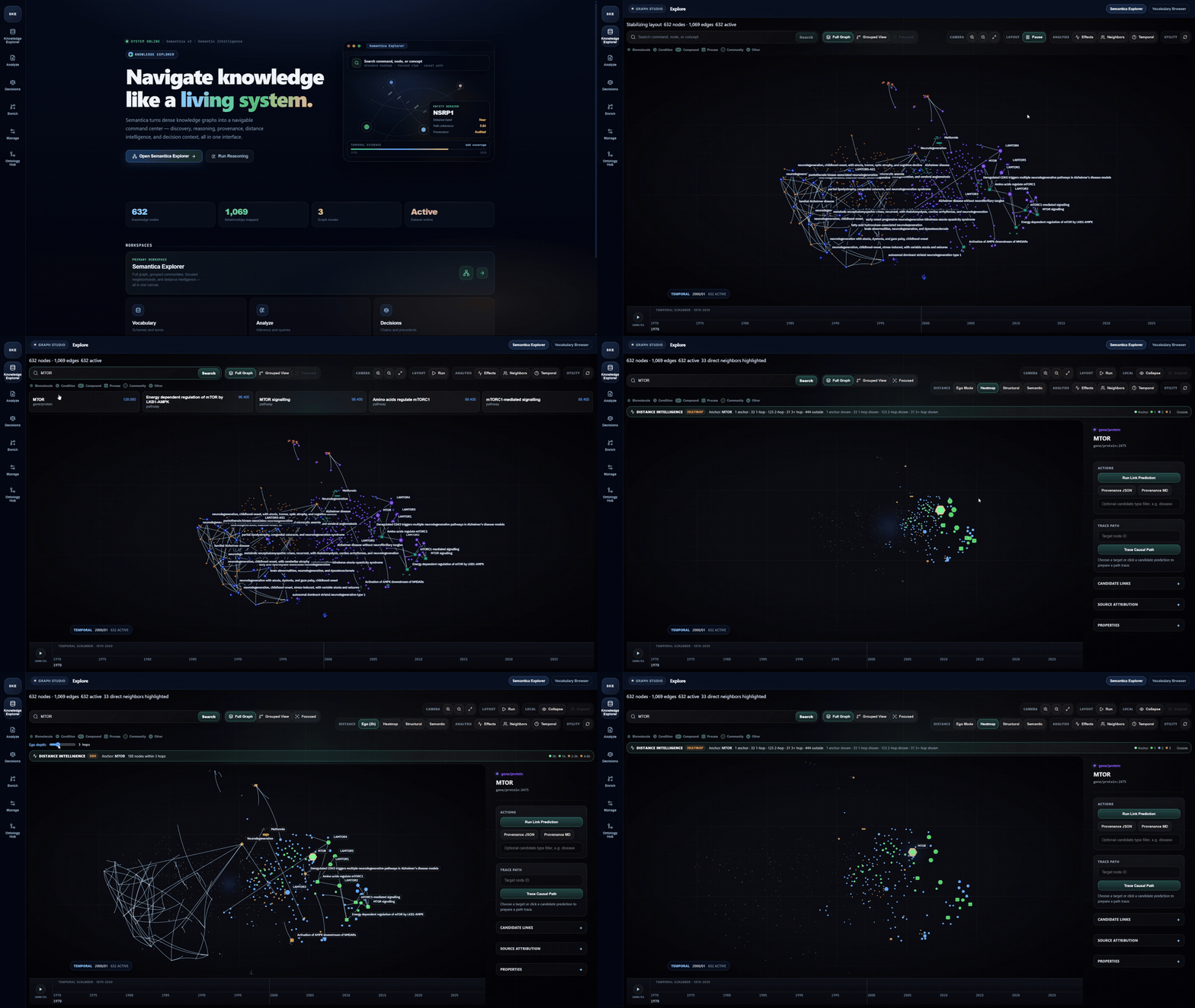
semanticaCLI utility for the command line. - A browser-based Knowledge Explorer interface built on React and Sigma.js for graph visualization, timeline tracking, and manual entity annotation.
Who Will Benefit from This Project
If you're building a simple pet project or a basic chatbot for knowledge base queries, Semantica would be overkill. Basic RAG on LangChain or LlamaIndex would be sufficient here.
But the project is definitely worth exploring if you're building agents for the financial sector, law, medicine, or cybersecurity. In these domains, the ability to show a complete decision history and guarantee business rule compliance becomes a critical product requirement.
Related projects